
Hydraulic Valve Blocks
Machined manifold blocks in steel, aluminium and stainless, with cartridge and subplate cavities cut to the published standard.
The circuit, in one solid block
A manifold block routes oil between pumps, valves and actuators through intersecting drilled passages. The block is only as good as its cavity and port geometry, which is why we machine cavities to the published standard and verify intersecting bores for breakthrough, then deburr every passage so no swarf reaches the system.
We machine valve blocks from steel, aluminium and stainless bar or forging on our own CNC centres. Send the circuit schematic with the cavity and port standards named, and we quote against those standards rather than estimate the geometry.
Specification
| FIELD | UNIT | ORISE VALUE |
|---|---|---|
| Block material grades | — | 45# / C45E · 40Cr · 42CrMo · Q235 / S355 · aluminium 6061 / 6082 · stainless 304 / 316 |
| Maximum block envelope | mm | 1000 × 500 × 500 on the machining centre |
| Maximum block weight on the machine | kg | 1200 |
| Cavity standards worked to | — | ISO 7368 (cartridge / slip-in) · DIN 24342 · ISO 4401 / NFPA D03, D05, D07, D08 (subplate) |
| Port thread forms | — | BSPP (G) · NPT · Metric (M) · SAE J1926 ORB · UN / UNF |
| Intersecting bore tolerance | — | To drawing · blind and through bores as specified · breakthrough verified |
| Cavity dimensional tolerance | mm | To the cavity standard table, typically ±0.05 on diameter and ±0.10 on depth |
| Port seat surface finish Ra | µm | Per the port standard, typically 1.6 to 3.2 |
| Pressure / leak test | — | Hydrostatic bench to 40 MPa, hold time to your specification, on request |
| Surface treatment | — | Zinc plating, phosphate, anodise (aluminium), black oxide or none |
| NDT / verification | — | Magnetic particle and pressure-decay test available in house |
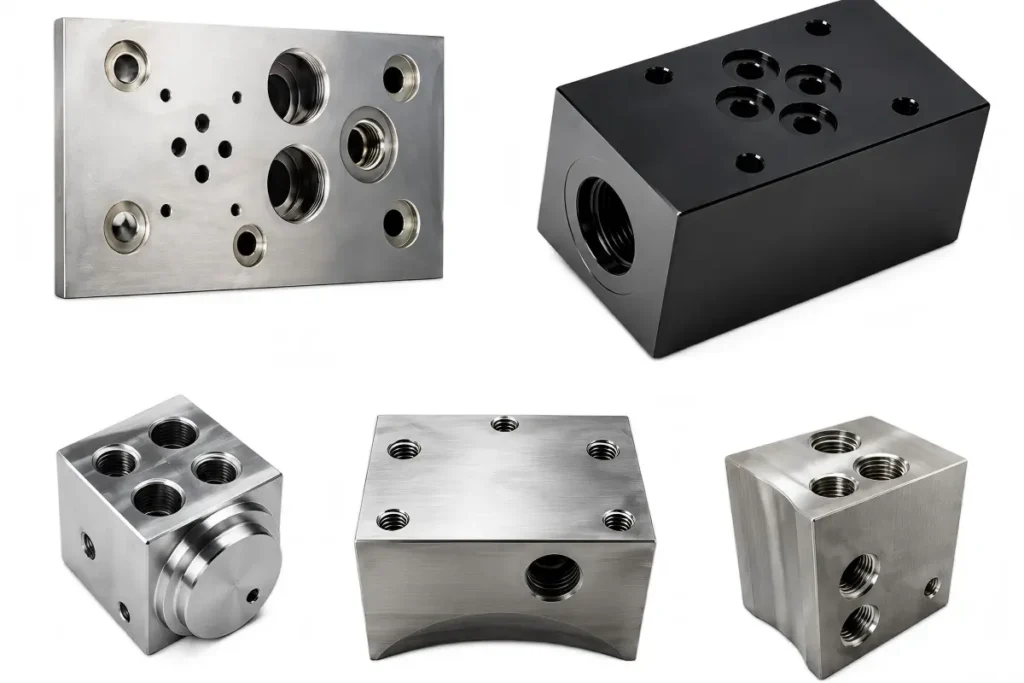
Cavities to standard. Cartridge and subplate cavities have published dimensional tables (ISO 7368, DIN 24342, ISO 4401). Machining to those tables means the valves you buy off the shelf actually fit, which is the difference between a block that assembles first time and one that needs rework.
Deburr the passages. Intersecting drilled bores leave breakout edges. We deburr and, where the circuit demands it, flow-test the passages so no loose swarf enters your system. State the cleanliness level on the drawing if it matters to the application.
What we need on the drawing
- Circuit schematic and the block envelope or footprint
- Cavity standard and size for every cartridge and subplate valve
- Port thread form, size and seal type for every port
- Required pressure rating and any test or marking requirement
- Material grade, or the fluid and duty environment if the grade is open
- Surface treatment and any tagging or serialisation requirement
Send the drawing
Quotation within 48 hours of a complete drawing package.