
Hydraulic Breaker Pistons
Hardened and ground replacement pistons to fit hydraulic breakers, produced from a drawing, a sample or a measured worn part.
The part our cylinder line was already making
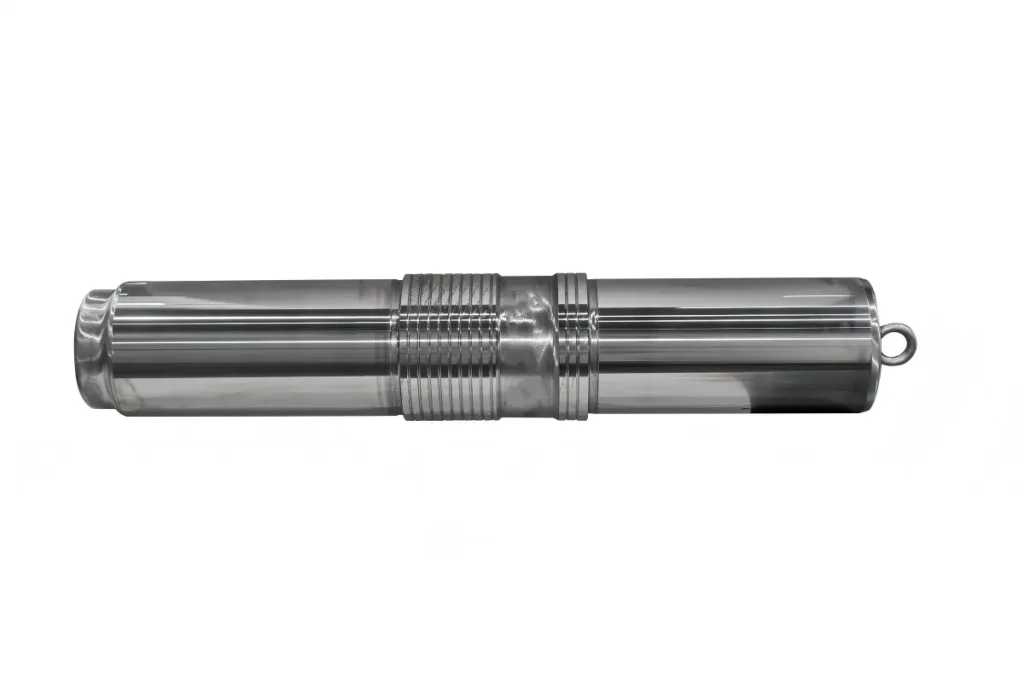
A breaker piston is a hardened, ground, close-tolerance cylindrical part with precise land and groove geometry. It is the same manufacturing problem as a cylinder rod with a harder specification, which is why it is the first breaker part we took on rather than the last.
Piston geometry controls the striking energy and the oil path timing. The land positions and widths are not cosmetic, and a piston copied by eye from a worn sample will run, sound and wear differently. We measure a reference sample properly before cutting metal.
Specification
| FIELD | UNIT | ORISE VALUE |
|---|---|---|
| Diameter range | mm | 68 to 180 |
| Length range | mm | 700 to 1700 |
| Diameter tolerance | mm | Set by the piston-to-cylinder running fit, typically 0.05 to 0.07 total clearance |
| Surface roughness Ra | µm | 0.4 maximum on the running lands, ground and honed |
| Straightness | mm/m | 0.2 |
| Material | — | 42CrMoA forged alloy steel · 40CrMo and 20CrMo where the drawing calls for a carburised piston |
| Surface hardness | HRC | 55 to 62 depending on the design |
| Core hardness | HRC | 38 to 42 |
| Hardening method | — | Integral quench and temper · carburise and quench on checkered-land designs |
| Route | — | Forge → rough machine → quench and temper → precision turn → grind and hone → final inspection |
| Batch record | — | Hardness and dimensional record retained per batch |
Send the worn part if you can. A worn piston tells us where the part failed and whether the failure was wear, seizure or fatigue. That often changes the material or the case depth we recommend.
Reverse engineering limits. We measure and reproduce dimensional geometry. We do not copy OEM markings, logos or trademarked shapes onto the part body.
What we need from you
- The machine brand and model designation
- The OEM part number if it is stamped on the old part
- A drawing, or a worn sample we can measure, or a 3D scan
- Whether the land geometry may be improved or must be replicated exactly
- Annual quantity, since it changes the tooling and grinding fixture decision
Send the part, the drawing or the model
A photograph with a scale rule and the machine model is usually enough to begin.