
Chisels & Moil Points
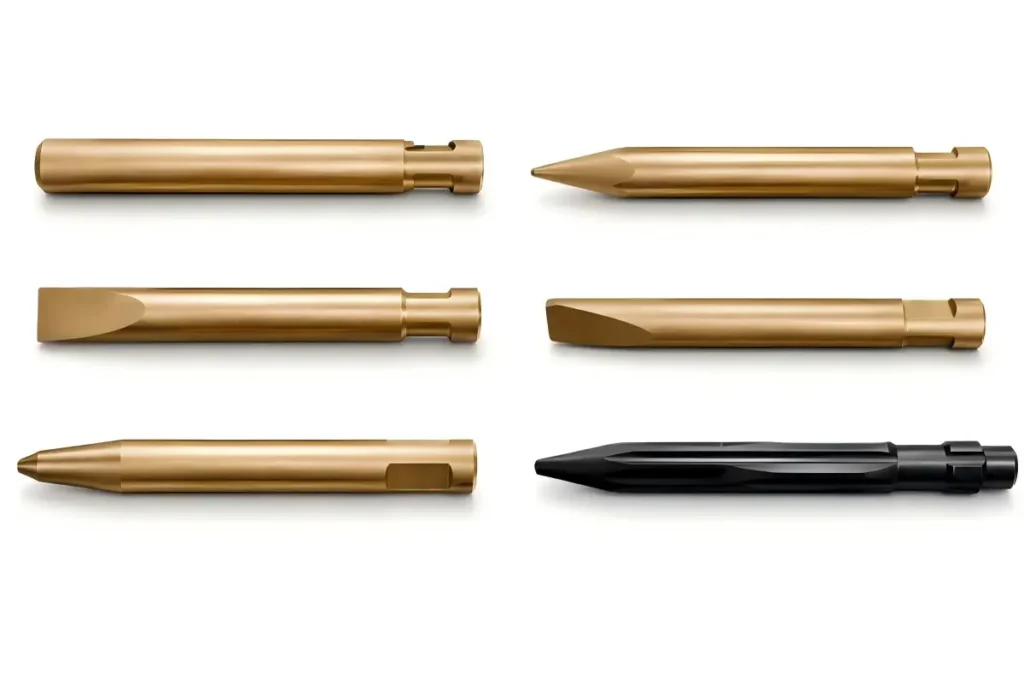
Moil points, chisels, blunt and conical tools produced through a forging partner, with the hardness profile stated rather than implied.
Made through a forging partner, and we say so
Breaker tools are forged, not machined from bar, and forging is not a process we own. We produce them through a qualified forging partner and control the specification, the heat treatment and the incoming inspection. That is a different claim from making them ourselves, and the difference matters to a buyer who audits.
What we do control is the specification and the verification: steel grade, surface hardness, case depth, core hardness and dimensional conformity, checked on receipt before anything ships.
Specification
| FIELD | UNIT | ORISE VALUE |
|---|---|---|
| Tool diameter range | mm | 40 to 210, matching the cross-reference table |
| Working length range | mm | 400 to 1600, paired to diameter |
| Tool forms | — | Moil point, flat chisel, blunt, conical, pyramid |
| Material | — | 42CrMo / 42CrMoA · 40Cr · 40CrNiMo on request |
| Surface hardness | HRC | 50 to 55 standard · 48 to 54 on large diameters |
| Core hardness | HRC | 35 ±3 |
| Segmented hardness profile | HRC | Tip 50 to 53 · centre 45 to 48 · tail 49 to 51, so the tail deforms before it cracks |
| Case depth | mm | 4 to 10 |
| Hardening method | — | Austenitise 810 to 850 °C, quench, temper 250 to 300 °C, then surface hardening of the working zone |
| Mechanical properties | MPa / % | Rm ≥1250 · Rp0.2 ≥950 · A 10 to 14 · reduction of area 35 to 40 |
| Grain size | — | 7.0 to 8.0 |
| Shank finish | — | Ground to the bushing running clearance |
| Incoming inspection | — | Hardness, dimensional and ultrasonic check on every batch |
Hardness is a trade-off, not a score. Harder tools resist wear and fracture more readily; softer tools mushroom. The right answer depends on the material being broken and the ambient temperature, which is why we ask rather than default to the highest number.
Forging is partnered, and we say so. Breaker tools are produced through a qualified forging partner and verified on receipt. Stating the partnership openly is not a weakness we hide; it defines exactly what we guarantee and what we only witness.
What we need from you
- Tool diameter and the machine model it fits
- Tool form required, and the material being broken
- Working length, and whether the shank retainer slots differ from standard
- Whether a dual-hardness profile is wanted for cold-climate or high-fracture work
- Annual quantity, as forging tooling cost is amortised across the run
Send the part, the drawing or the model
A photograph with a scale rule and the machine model is usually enough to begin.